Just Love Forest is not a place most people stumble upon.
It’s a place you are led to.
You didn’t arrive here by accident.
This land carries a blessing that is rare and quietly powerful. Just beyond the noise of modern life, it rests a stone’s throw away Chattooga Town, once one of the most vital Cherokee cultural centers of life, governance, learning, and ceremony. Indigenous peoples lived, prayed, traveled, and made decisions here in deep relationship with springs, forest, and red clay. The land still holds that imprint.
Later, this place was renamed Poetry by Serpentfoot, a local legend as a poet and spiritual provocateur who believed that the forest is the master teacher and that we are all just, “a little part of nature.” Her presence anchored a radical idea here: that spirit does not belong only in temples or texts, but in the body, in the earth, and in daily life lived with conscience. Hear our first conversation with her here.
Today, Just Love Forest carries these lineages forward as something increasingly rare, a 716-acre conservation ashram devoted to protecting nature while offering refuge for people. Especially in the Southeast, places held explicitly for spiritual practice, compassion, and long-term stewardship of the land are few and far between.
This is not a place to consume experiences.
It is a place to be changed.
If you feel drawn here, it may be because something in you recognizes what this land remembers: you are part of it.
We invite you to step into this story, not as a visitor, but as a participant in something living.
The Ancient Appalachians and the Memory of the Sea
The Appalachian Mountains are among the oldest mountain ranges on Earth.
Long before the Himalayas rose, long before the Rockies were formed, these mountains already existed. They have been worn down and reshaped over hundreds of millions of years, softened by time, water, and erosion. What remains is not dramatic height, but great age, a depth that is felt more than seen.
The Appalachians carry a kind of quiet lore. Not the lore of sharp peaks and sudden upheaval, but the lore of endurance. These mountains have witnessed oceans come and go, continents collide and separate, and life emerge, vanish, and return again.
Here at Just Love Forest, that deep history is not abstract.
Along the trails near Basecamp, we regularly find fossilized seashells embedded in stone and soil, clear reminders that this land was once beneath an ancient sea. These shells are not rare museum pieces; they appear casually, unexpectedly, underfoot. A spiral. A ridge. The unmistakable curve of something that once lived in saltwater, now resting in forest clay.
To hold one is to feel time collapse.
The presence of seashell fossils here tells a geological truth: hundreds of millions of years ago, this region lay beneath a warm, shallow ocean. Layers of sediment accumulated on the sea floor, compressing over immense spans of time into limestone and other sedimentary rock. Later, tectonic forces lifted those layers upward, folding them into mountains. What was once ocean became ridge. What once held fish and shell became trail.
This knowledge changes how the land is felt.
When you walk these paths, you are not just moving through forest you are walking on the remnants of an ancient sea. The ground beneath your feet has already lived many lives. It has been water, pressure, darkness, uplift, and erosion before becoming soil again.
Many people describe a feeling of humility when they encounter these fossils. Others feel awe. Some feel a strange comfort. The body seems to recognize something older than memory, a reminder that change is not an interruption of life, but its most consistent pattern.
This is the backdrop for everything else that unfolds here. Before human trails, before ceremony, before names or towns, there was ocean. And before ocean, something older still.
The Appalachians do not announce their power loudly. They speak through time, through stone, and sometimes through a small seashell resting quietly on a forest path.
Iron, Quartz, and the Quiet Physics of a Vortex
When people speak of vortexes, they are rarely speaking about a single force. They are speaking about convergence.
Across the world, places described as energetically powerful tend to share a similar underlying condition: the meeting of ancient stone, mineral density, and moving water. In particular, two elements appear again and again in these landscapes, iron and quartz.
Iron carries weight. It anchors. It draws energy downward into the earth and into the body. Quartz, formed under immense pressure and heat, holds structure and clarity. It stabilizes and organizes. When these two coexist in the ground, especially in land shaped by great age and slow movement, they create a field that many people experience as grounding, coherent, and alive.
This is not mythology alone. Iron-rich soils and quartz-bearing stone interact subtly with electromagnetic conditions, especially in the presence of flowing water. At the same time, these same materials affect the human nervous system through sensation, gravity, and perception. The body responds before the intellect arrives.
At Just Love Forest, both iron and quartz are present in abundance throughout the land.
The red clay beneath the forest floor carries iron in visible abundance, staining stone, soil, and skin after rain. Quartz appears more quietly, threaded through rock, scattered in creek beds, embedded in the ancient Appalachian bedrock. Springs move through this mineral-rich ground continuously, rising, traveling, and returning again.
Together, these elements create not a dramatic surge of energy, but a gathering one.
Rather than lifting awareness outward, the land draws it inward. Breath slows. Muscles soften. Thought loosens its grip. Many people feel heavier in the best sense of the word, more present, more settled, more here. This is the hallmark of a grounding vortex: not stimulation, but coherence.
Just Love Forest is not Sedona. There are no towering red spires announcing power from a distance. The force here is quieter and older. It comes from the slow companionship of iron and quartz, from water moving patiently through stone, from mountains that have already lived through oceans and upheaval and learned how to rest.
If vortexes are places where energy gathers rather than scatters, where the body remembers how to belong to itself, then this land carries that quality deeply, expressed not in spectacle, but in steadiness.
Here, the power does not pull you away from yourself.
It brings you home.
Indigenous Land Acknowledgment and Historical Context
Just Love Forest exists within the Ridge and Valley province, one of the oldest continuously inhabited regions in what is now Georgia. Human relationship with this land reaches back thousands of years, long before the Mississippian cultures and long before the arrival of Europeans. For centuries, this region was home to many Indigenous Nations whose lives were shaped by forest, water, soil, and seasonal rhythms, and whose systems of governance, learning, agriculture, and spiritual life long predate colonial settlement.
Prior to European invasion, more than twenty Indigenous tribal groups lived across what would later become the state of Georgia. These Nations understood land not as property to be owned, but as a living gift entrusted to human care. The land was something to tend, steward, and pass forward in balance for future generations.
Beginning in the sixteenth century, with Spanish incursions of Desoto around 1540 and accelerating through British colonization in the seventeenth and eighteenth centuries, Indigenous life across the Southeast was catastrophically disrupted. Disease, enslavement, warfare, and displacement led to population losses estimated at over ninety five percent in some regions. Colonial powers imposed foreign concepts of land ownership, debt, and extraction, fundamentally altering Indigenous relationships to place.
The British colony of Georgia, claimed by James Oglethorpe for the Crown, stretched in theory from the Atlantic Ocean westward to the Mississippi River. As settlers pushed inland, treaties were imposed on Indigenous Nations, often through coercion or manipulation. Trade goods and metal tools were exchanged for furs and deer hides, creating artificial debts that could never be fully repaid. As deer populations were depleted, colonial authorities began demanding land cessions instead, accelerating dispossession across the region.
Koasati - The First Known Inhabitants of This Region
Among the earliest known inhabitants of northwest Georgia were the Koasati people, also known historically as Coushatta. Koasati is pronounced koh uh sah tee and comes from the people’s own name, Kowassati, meaning white cane people. Their presence in the Southeast reaches back to the Mississippian Period, roughly AD 900 to 1600, though their cultural lineage extends further still.
The Koasati were agriculturalists who cultivated corn, beans, and squash, supplemented by hunting and fishing. They were skilled basket makers, particularly known for longleaf pine needle basketry that continues to be practiced today. Over time, Koasati towns became part of what Europeans later labeled the Muscogee or Creek Confederacy, a loose alliance of autonomous towns connected through language families, ceremony, kinship, and mutual defense.
Though participating in this broader Muscogee world, the Koasati retained their distinct language, identity, and traditions. Today, Koasati communities continue in Louisiana and Alabama, preserving language, crafts, dances, songs, and foodways that carry forward their ancestral knowledge.
Naming the Koasati here is not a symbolic gesture toward a distant past. It is an acknowledgment that this land was known, inhabited, and cared for long before colonial boundaries and political labels were imposed.
The Muscogee Presence and Removal
For generations, Muscogee peoples lived throughout what is now central and northern Georgia. Their towns were organized around fertile valleys and waterways. They practiced agriculture, managed forests with fire, and oriented life around water, soil, and ceremony. Springs and rivers were living presences, not resources to be extracted.
At the heart of Muscogee spiritual and civic life was the Green Corn Ceremony, an annual ritual of renewal marking the ripening of corn. This was a time of fasting, forgiveness, purification, and gratitude. Old grievances were released, fires were renewed, and the community began again together. Corn was not merely food but a sacred bond between people, land, and season.
After the American Revolution, pressure from the state of Georgia intensified. A series of treaties, often coerced or signed by limited representatives, stripped the Muscogee Nation of vast territories. Following the Creek War of 1813 to 1814, the Treaty of Fort Jackson forced the Muscogee to cede more than twenty million acres, including large portions of Georgia. By 1827, Muscogee peoples had been removed westward to Alabama and later to Indian Territory in Arkansas and Oklahoma.
Their removal did not mean the land became empty. It created a vacuum that invited further colonial expansion and set the stage for the next chapter of displacement.
Cherokee Settlement, Chattooga Town, and the Springs
As Muscogee lands were taken, Cherokee communities consolidated and expanded settlement into northwest Georgia. By the late eighteenth and early nineteenth centuries, Cherokee towns, farms, and governing centers were well established throughout the region.
Chattooga Town, located in what is now Lyerly, Georgia, sat within the immediate cultural and geographic landscape of what is today Just Love Forest. For a brief but critical period in the early 1830s, Chattooga Town functioned as a seat of Cherokee governance when other centers became unsafe under increasing pressure from the state of Georgia.
This region is also associated with Sequoyah, who developed the Cherokee syllabary nearby. The syllabary enabled widespread literacy within a single generation, strengthening cultural continuity and sovereignty at a moment of escalating external threat.
Cherokee movement through this land followed water, contour, and seasonal knowledge rather than fixed roads. Springs served as points of orientation, rest, gathering, and ceremony. The land now known as Just Love Forest contains a notable concentration of natural springs aligned in patterns consistent with historic Cherokee travel logic. These spring to spring pathways connected towns such as Chattooga with surrounding valleys and ridgelines, forming living trails shaped by attentiveness to land rather than domination.
Removal and the Trail of Tears
Despite efforts at accommodation and legal resistance, Cherokee sovereignty was not respected. The Indian Removal Act of 1830 authorized the forced relocation of Indigenous Nations east of the Mississippi. Georgia nullified Cherokee laws, seized gold rich lands, and distributed Cherokee territory through the Cherokee Land Lottery.
Between 1838 and 1839, Cherokee people were forcibly removed along routes that passed through and near this region. Thousands died from exposure, disease, starvation, and exhaustion. The Trail of Tears marked one of the most devastating acts of forced removal in United States history.
A Landscape of Successive Displacement and Enduring Memory
The land now called Chattooga County bears the imprint of successive removals. Muscogee peoples were displaced first, followed by the Cherokee a generation later. Each removal was justified through legal language and enacted through violence and coercion.
Understanding this sequence matters. The Cherokee did not simply replace the Muscogee. Both Nations were caught in the same expanding machinery of colonial displacement. The land itself holds this layered memory.
We offer this acknowledgment not as a closing statement, but as a living commitment. To remember that this land was never empty. To steward it with humility. To care for water, soil, forest, and future generations in a way that honors the Indigenous peoples who understood stewardship not as ownership, but as responsibility carried forward in time.
The Civil War and a Fractured Land
The Civil War passed through this region like a deep wound.
Northwest Georgia sat close to major theaters of conflict during the American Civil War, particularly as armies moved through the Appalachian foothills and surrounding valleys. Rail lines, supply routes, and rural farms were drawn into a war that reached far beyond the battlefields themselves.
Though no major battles are recorded directly on this land, the war reshaped daily life here. Farms were stripped for food and forage. Rail corridors were contested and disrupted. Families were divided, sons sent away, and uncertainty settled over communities that had already endured generations of displacement and upheaval.
For many in this region, the Civil War was not experienced as grand strategy or ideology, but as loss of labor, of stability, of life. Enslaved people seized moments of chaos to escape when they could, while others endured continued bondage until emancipation arrived unevenly and incompletely. The war’s end did not restore what had been broken; it marked the beginning of another long period of reconstruction, scarcity, and change.
The land absorbed this chapter as it had absorbed others.
Fields once worked were abandoned or replanted. Rail lines were repaired, rerouted, or left to fade. Forest slowly reclaimed what violence and extraction had disturbed. What remained was not triumph, but endurance.
To acknowledge the Civil War here is to recognize that this land has been shaped not only by ceremony and cultivation, but also by conflict imposed upon it. It has known division as well as belonging. And yet, like the mountains themselves, it endured, holding memory without becoming defined by it.
Rail, Orchard, and the Long Path Through the Land
After removal, the land entered another chapter of human use, one shaped by agriculture, rail, and rural life rather than ceremony and council.
In the late nineteenth and early twentieth centuries, this area was part of an agricultural landscape sustained by small farms, orchards, and local trade. The community then known as Tulip was not a town of grand scale, but it was active and productive. The surrounding land supported crops and livestock, and the climate proved especially favorable for fruit.
Just beyond what is now Just Love Forest, near Kincaid Mountain, stood a well-known peach orchard and a small hotel that served travelers and workers moving through the region. Peaches from this area were valued for their flavor and resilience, and orchards once dotted the hillsides. Even today, remnants of that era remain. Scattered through the forest and along old clearings, a few of those native peach trees have survived, gnarled, feral, and still bearing fruit, quietly persisting long after the structures and commerce that once surrounded them have disappeared.
The railroad was the artery that made this agricultural life possible.
Tracks were laid through the landscape, connecting Tulip and neighboring communities to wider markets and movement. The railroad carried peaches, timber, and goods outward, and brought people, news, and supplies inward. It reshaped how the land was accessed and understood, carving a linear path through hills that had once been navigated only by foot, animal, or wagon.
Over time, the trains stopped running. The rails were pulled up. But the path remained.
Today, the old railroad grade that visitors cross as they arrive at Just Love Forest has become Simms Mountain Trail, part of the Pinhoti Trail. What was once an industrial corridor has been reclaimed as a footpath, carrying hikers rather than freight.
The Pinhoti Trail stretches hundreds of miles, linking forest to forest and ridge to ridge. It runs north through Alabama and Georgia to Springer Mountain, where it connects with the Appalachian Trail, continuing all the way to Maine. To the south, its broader network reaches toward the Gulf Coast, all the way to Key West, tying this quiet forest into one of the longest continuous walking routes in the eastern United States.
Serpentfoot and the Naming of Poetry
Tulip was a frontier town in Chattooga County, as a station on the Central of Georgia Railroad, located near the Floyd County line. The name is derived from the tulip tree (yellow poplar) Liriodendron tulipfera that is found throughout the Basecamp area of Just Love Forest.
It was re-established as the town of Poetry in 1973 by Anne C. Otwell, who later changed her name to Serpentfoot Serpentfoot, who wanted to put "poetry" on the map, and create a colony of poets.
Anne Clay Otwell was well known in Georgia as a poet, editor, and publisher of the “Poets Monthly” paper. She was also president of the Poets of Georgia Club, and mayor of a ghost town once called Tulip (also previously called Sprite and Kincaid) located in Chattooga County, Georgia.
She renamed the town Poetry, Georgia and intended to create a colony of poets there, attracting visitors such as President Jimmy Carter to whom she presented an award on behalf of Poetry.
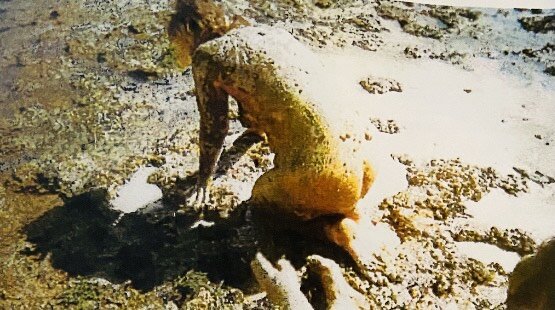
After going broke, she lived as a hermit in the woods of Poetry, Georgia in a teepee and lived completely off of the land for a year. She later wrote her book, the “Bad News Gospel.” She also started the "Church of Nudist Native and Naturalist with a Mission / NNNWM also known as “Our Greater Self Co-op.” The picture on the header is one of her old pictures shared of their nude mud bathing many years ago. The primary message is that “we are nature.” She remarked that the first clothes weren’t leaves, they were mud. “We are just a little part of nature,” she often exclaims.
In 1995, Anne Otwell legally changed her name to Serpentfoot Serpentfoot. She offers, what is all foot and no foot? The serpent. Serpentfoot's "Bad News Gospel" is a work in progress as 1970s news clippings, typescript, and snippets of printed text, with handwritten explication in the margins dated as recently as 1996.
She was jailed for three years of a five year sentence for speaking out against Christian prayer being used in government meetings due to separation of church and state. She protested by removing her clothes at the town hall meeting and proclaiming, “behold, God in the flesh,” to make the point that God is everywhere and in everyone and shouldn’t be relegated to a single religious practice.
She had multiple degrees from Berry College and Georgia Highlands College in Law, Religion and Anthropology. She still resides where there used to be a historic Native American log cabin, until it burned down.
Today, Poetry remains an unincorporated community, its name a quiet inheritance from a woman who insisted that language, land, and conscience were inseparable. The presence of Serpentfoot is part of this land’s layered story, not as myth, but as lived history, reminding those who come here that how we name a place shapes how we treat it.
Inspired by the wisdom of the beings who gathered here before us, we remember we are just part of nature.
After writing a letter to Serpentfoot she agreed to meet and the link below is the recording of our conversation in her home nearby the entrance to Just Love Forest. She visits regularly and we honor her as a matriarch.
Listen to our first meeting with Serpentfoot
Read an interview with Serpentfoot
Bala, Ram Dass, Neem Karoli Baba, and the Emergence of Just Love Forest
After centuries of movement, rupture, and return, the land returned to a quieter phase, one shaped less by extraction or transit and more by listening.
After series of experiences that carried the clear mandate to “get a forest for healing,” Bala arrived not with a plan to build a destination, but with a question: how to live in right relationship with a place that had already lived so many lives. He did not know any of the recent history of this land when he was lead to it. It seemed to be calling people back to remember truths that can only be found in nature once again.
A student of the spiritual teacher Ram Dass, whose teachings emphasized love, service, and the practice of awareness in everyday life, Bala was also deeply influenced by the lineage of Neem Karoli Baba, an Indian Saint known to many simply as Maharaj-ji. This lineage carries a simple but demanding instruction: love everyone, serve everyone, feed everyone and tell the truth.
When Bala encountered this land, it was not experienced as empty or available, but as already speaking. The red clay, the mountain tops, the springs, the old trails, all suggested that the land itself had been preparing to return more closely to its original kind of relationship with humans. One rooted not in ownership, but in stewardship.
Just Love Forest emerged gradually from that listening and surrender.
Rather than becoming a retreat center in the conventional sense, the land is also held as an ashram in the truest meaning of the word: a place of refuge, remembering and practice. Not bound to one religion or path, but grounded in shared values of unconditional love, compassion, service, and presence. This, once again, is now a place where spiritual life is not separated from daily life, and where the forest itself is understood as teacher.
Here, practices unfold slowly. Forest therapy, meditation, ceremony, grief tending, silence, song, shared work. No single tradition is elevated above others. What matters is the sincerity of attention and the willingness to show up with humility. The land is not used to produce experiences, but to support relationship with self, with others, and with the all of the living world.
In keeping with this intention, the land has been protected in perpetuity under a conservation easement and stewarded with long-term care in mind. Development is minimal and deliberate. Quiet is honored. The forest is allowed to remain forest. Trails follow the land rather than impose upon it. The goal is not growth for its own sake, but continuity.
In this way, Just Love Forest becomes a meeting point of many lineages.
The ancient Appalachians.
The Muscogee and Cherokee peoples.
The red clay and the springs.
Poetry named into being.
And now, once more, a living practice of love and service.
Nothing here is meant to replace what came before. It is meant to remember and tend it.
To arrive at Just Love Forest is not to escape the world, but to remember how to belong to it. The land has carried many stories. This is simply the one it is telling now. Now you are part of this story, unfolding.
Welcome to our forest family.
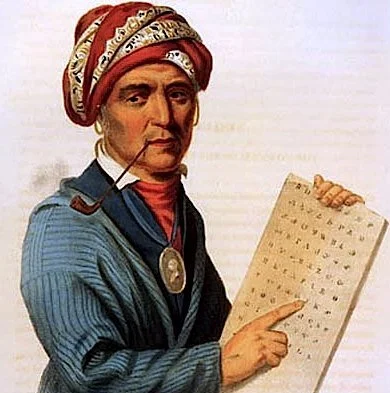
Sequoyah, Cherokee scholar and innovator, developed the syllabary that enabled widespread Cherokee literacy within a generation.

Serpentfoot and Bala on the summit of Bhakti Mountain, Just Love Forest, Poetry GA.
